
It’ is hard to believe we have already made it to March. Hopefully we can get past some of these freezing temperatures and welcome the spring weather into the shop very soon. We also hope everybody had a restful February break, but now its back to work in the shop. One item of note is we have received our new Bambu Labs X1 Carbon 3D printer. This printer was part of a grant won by the shop from the Medford Education Fund. We look forward to putting this printer through its paces and make some amazing new projects! Additionally, the shop also received nearly $180,000 in donations from Vecna Robotics. Much of the equipment we are receiving is radar and Lidar sensors for our ongoing autonomous vehicle project. Now, on to the student work.
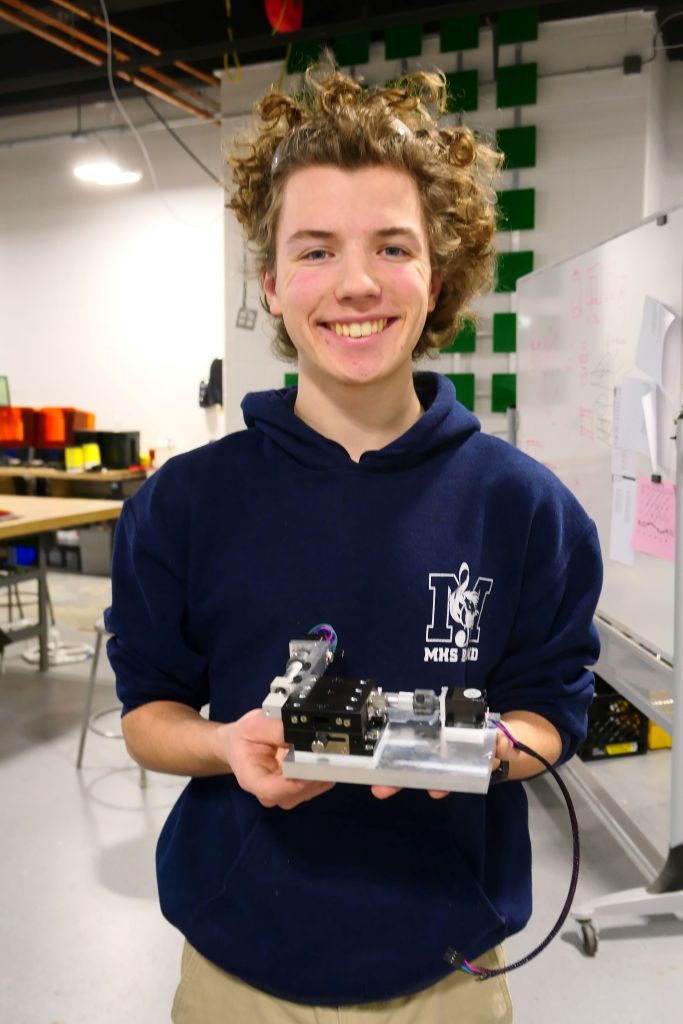
This week Senior Sacha Silvia continued his work on the automatic shades for the shop:
This week we returned from a nice week-long break. It took me a little bit to remember where I left things off, but I realized that I had been working on the hardware side of the blinds project by getting a new motor controller set up with a breadboard schematic. I resumed where I left off on the blinds because I was in a good place to transition over to start working on the software side of things. I was able to get the motor to spin in both directions via software (not very hard) but I didn’t get around to controlling the speed of the motor. To control the motor with the ESP32 I’ve been using a library and a guide that comes from a developer, Rui Santos, who was been a huge help in nearly all of my projects using an ESP32. Following his guide, I was able to get a pretty good understanding of how the motor control code worked, and it also helped me start on controlling the motor position using a slider on a web server, which was pretty similar to what I did in the past for the word clock.
After working on some of the code, I decided to do a fun mini project. The idea behind the project was to make a handheld foam roller that I could keep in my car so I can use it at practice without having to bring my big foam roller from home around. I had the idea to use a main handle bar as a grip with a tube-shaped piece of foam to go around it that acted as the roller portion. Fortunately, we had some pool-noodle-like material in the shop and I knew I would be able to use it for this. I experimented with using PVC and also using metal pipe. I ended up using some light weight aluminum pipe, which wasn’t my first choice, but we didn’t have any PVC smaller than half inch, and the opening in the foam was too small. After I put the foam cover over the handle, I secured the foam by wrapping it in electrical tape to stop it from potentially splitting open and also gave it a tighter fit on the rod so that it won’t slide off.
The last part of my week I spent working on the Digital clock as I finally found a good piece of wood to cut out the parts in. I was looking around in the leftover wood that former students bought for projects, and I found a 4ftx20in piece of wood that somebody had left behind, and it happened to be 1/4″. I checked in with my teacher and I was able to use it so I worked on a big file in inkscapethat would have all of the 1/4″ pieces be cut on the same document. This was nice because overall I will be using way less material and saving a ton of time. The wood is also the right amount of layers to be properly cut by the laser cutter, so I should be able to actually finish the digital clock (besides the electronics), which I’m super excited about.
See more of Sacha’s work at his website, linked here.
Junior Alex Pilika was between projects and spent time looking for his next idea:
I spent most of this week looking for new projects and working on an idea I had for some form of makeshift night vision goggles.
I got this idea when I noticed that I had an unused raspberry pi NoIR camera at home. The name NoIR is a play on words of the fact the camera has no IR filter (NoIR filter) meaning the camera can also see IR light, enhancing night visibility at the cost of slightly messed up colors on day shots.
While I have yet to test its night functionality, I have been able to test it with some IR LEDs.
Since I didn’t have the opportunity of testing the camera at night, and I wasn’t really sure how to continue, I decided to check out Mr Christy’s guides on writing a python webserver using the Pi.
At some point I hope to get a web interface working for the goggles, but as of right now I just want to get it working. I need to bring in a screen the Pi can use to display the camera footage, and either make or get some sort of IR led ring to illuminate the cameras vision (even with the night functionality, everything remains pretty dark).
Today (Friday) I got my pi zero 2 from adafruit, which I hope to use in place of the 3B+ because of its lower power usage. I hope to also get a PiSugar battery pack for this along with the screen.
Next week I hope to get the Pi displaying video feed on a small portable screen, and begin working on an enclosure in Fusion.
You can check out more of Alex’s work on his website, linked here.
Our Sophomores are presenting their LED Lightboxes to the class on Monday 3/3, so we will have more to share about them next week.
The Freshmen are hard at work on our guides, last week they spent their time on CAD and making name placards for their shop lockers.
All for now!


You must be logged in to post a comment.