
This week, students made visible strides in both mechanical assembly and electronics design, advancing their individual projects under challenging constraints. Their work underscores the iterative nature of engineering—mounting components, troubleshooting signal failures, and building circuit boards all require patience, persistence, and careful attention to detail.
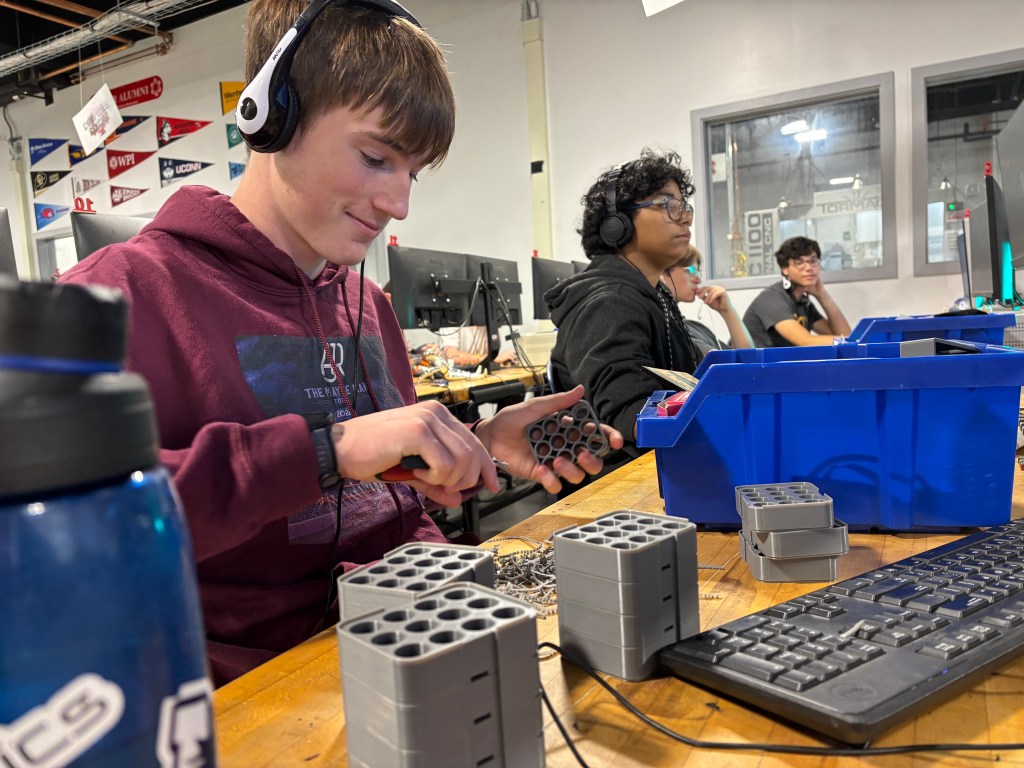
Euan focused his energy on the rover prototype, aiming to bring its mechanical systems together. He began by crimping wires and attaching female connectors in preparation for motor installation. Next came a scavenger hunt through the shop to locate appropriately sized nuts and bolts—he noted this consumed more time than expected, due to limited stock of the correct parts. Once the hardware was sourced, he mounted all six motors and proceeded to 3D print the remaining wheels. On the electronics side, Euan revived the transmitter/receiver setup he had tested previously. The first round went well, but soon the signal failed entirely: motors spun without following joystick commands. After methodically ruling out loose wires and coding errors, he replaced both the transmitter and receiver hardware and restored signal control. The moment of truth came when he tested the fully assembled rover—motors and drive functions worked as intended. Euan admitted he didn’t have time to fully test all capabilities, but the fact it moved under control marked a major milestone. Euan R723
Andrew turned his attention this week to a more compact challenge: a macropad prototype as a stepping stone toward a full keyboard. He gathered all required parts—Cherry MX switches, diodes, an encoder, and a KB2040 microcontroller—and then tackled the schematic. Drawing on a tutorial, Andrew simplified wiring in the schematic using labels instead of direct connections, which made the layout cleaner and more manageable. He designed a double-sided PCB so switches sit on top while diodes and the KB2040 lie underneath. During layout, he adjusted pad and hole sizes to prevent milling issues; in doing so, he noted that some pads now touch plastic parts of the switch bodies, so he flagged that for further inspection. With the PCB schematic mostly complete, he plans next to create a 3D model of the PCB, finalize the chassis design, and order components like switches and diodes. Andrew Huang Po
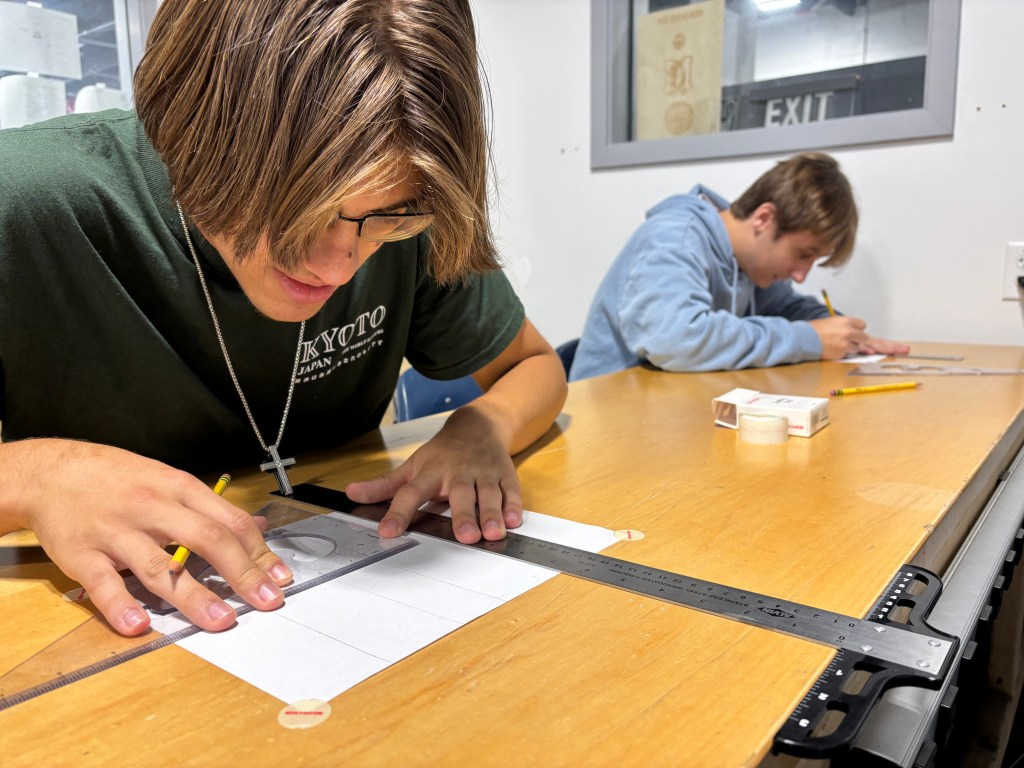
Sophomore began their hand drafting unit. They began learning about drafting tools such as T squares and Triangles, and then drafted different shapes to correct dimensional units. Next week they will return to coding and circuitry with Mr. Christy.


 MVTHS Engineering
You must be logged in to post a comment.