

This week in Engineering saw students tackling both design challenges and fabrication tasks, refining ideas while integrating feedback and real-world constraints. Below are highlights drawn from Adam and Sydney’s blogs, showing how they navigated setbacks, tooling limits, and iterative improvements in their projects.
Adam dove back into his weather display project, working to refine his sketches in CAD. He encountered frustration with Fusion 360’s circular pattern tool—“for some reason decided that it just did not want to be constrained”—so he stepped away, regrouped, and later traced his imported images, re-learned spline constraints, and extruded the shapes into 3D form. He plans to laser-cut the back plate from acrylic and engrave, rather than cut, to preserve the design. He envisions LEDs lighting up behind individual weather symbols, with a seven-segment display in the center to show temperature. Meanwhile, Mr. L introduced a new class “mane” (module) on Fusion to help students improve their CAD skills. Adam struggled at first—the pre-test included many topics new to him—but he pushed through, completing eight modules by midweek, even in spite of WiFi outages that forced computer reimaging. (Adam Lewis)
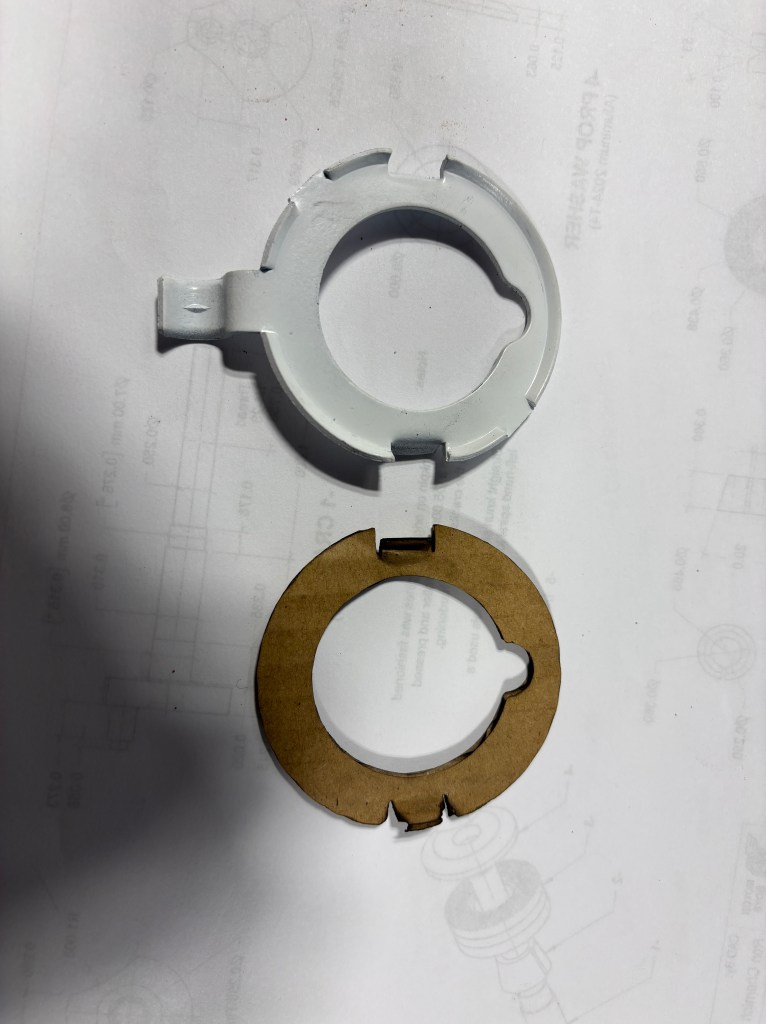
Sydney’s week was marked by both project progress and time away from robotics class. After being absent two days, she began the week by updating her “About Me” and “Resume” pages on her robotics website, reflecting on the experience she’s gained in the shop. Then she turned to a hands-on assignment: recreating a ring for a friend of Mr. L’s. She measured and transferred dimensions into CAD, test-cut the design in cardboard to check tolerances, and found that a critical inner radius (fillet) had to be increased. After adjusting from 1 mm to 4 mm and re-testing, she successfully cut the ring from metal and sent photos to the recipient for approval. The final step will be bending its edges in the metal fabrication area after confirmation. While waiting on the laser cutter, Sydney also organized a sewing box project. She designed and 3D-printed two boxes: initially wall thickness was 0.2″, but she reduced it to 0.1″ to save filament while retaining sufficient strength. She also adjusted the lid’s internal dimensions so that it stays secure but is easy to remove. (Sydney’s Robotics Projects)
Our Sophomores continued their last push to get through OSHA 10 modules. The OSHA 10 module is a requirement before students can safely utilize the machinery in our shop. They will get back to some more fun stuff next week.


 MVTHS Engineering
You must be logged in to post a comment.