

This week marks the end of February and the beginning of March – hard to believe we are already entering the spring season! Students were eager to get back to work after a relaxing break, and there are a lot of projects happening.
Junior Nate Materazzo continued his work on his video game:
This week I returned to working on my video game project after February break. First, I imported some new character and map assets that I had made over the break. I added 2 new characters, along with their animations, which I think turned out pretty good. This can be seen in the bottom-most video.
After I got done making the animations work for the 2 new characters and the new map I made, I started coding for a tournament-style mode within the 1-player mode. To do this, I had to create a randomizer in my code with the different character’s icons, and then assign each of them values for their seed number, and the number of which player icon it was, so I could record which one was which. Then, using RNG’s and game object duplicators, I made it so the tournament could go on for the first and second rounds (given that the player wins those games, so the tournament can continue), and those games that the player was not playing in would be simulated using an RNG that also takes into account the likelihood of a higher seed losing to a smaller seed. The seed randomizer is seen in the first video below, so all the player’s icons are randomized, but the player characters will always be the number 10 seed, no matter which player is chosen. The video does not show the first and second round’s simulation that I have coded for.
Go to his website at this link to see video and images of the game.
Senior Roman Rice continues his work on the autonomous vehicle project. This week he was fixing some motor control issues:
This week the circuit board for the motor control arrived and I began work on getting it to function properly.
However as I started to work on assembling it, luckily before soldering the mosfet driver circuitry I found I very noticible flaw with the mosfet driver circuit.
Posted: 29 FEB 2024
Week of 29 FEB 2024
This problem lies in the fact that the mosfets which I am using are PMOS, meaning that their gate needs to take an input as a voltage differential from the switching power, and not ground.
This is something which makes designing circuits using PMOS complicated as ground is normally used as a reference but here it has to be the inverse.
The important detail which I ommited when designing the circuit was that one of the mosfets needed to swtich a 72V input, however I ommited to correctly set up the schematic in order to keep the gate source voltage differential to less than the breakdown(max) value.
As such for one of the mosfets I will have to use some external circuitry to correctly control the drive. For the final circuit in particular I intend to use dedicated mosfet drives for all of them to ensure that such problems do not happen.
Originally this was not caught because I did most of the testing at lowever voltages that did not interfere with this, now however, I feel that I have much better learned how to work with PMOS and believe that this will be of great use to me in the future.
* In the image below please reffer to the lack of any circuit to deal with voltage division on the mosfet’s input.
Learn more about his project at his website, which you can access by clicking this link.
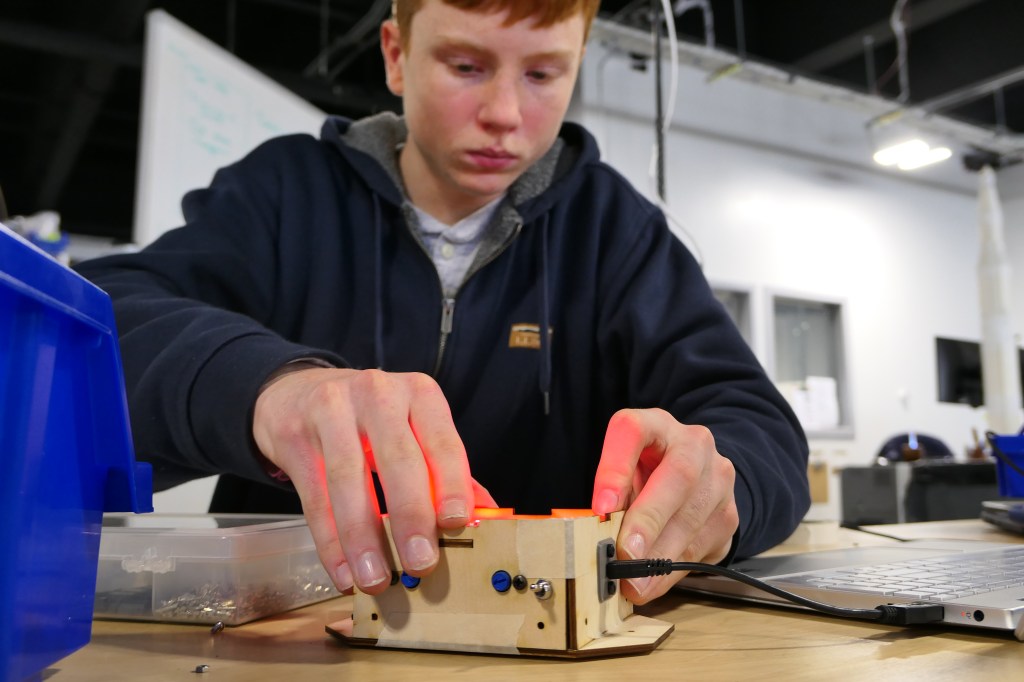
It was the final push for sophomores to complete their LED Lightbox projects, and we are excited to share those with you next week.


 MVTHS Engineering
You must be logged in to post a comment.